What does a code violation notice for my roof actually mean?
A code violation notice for your roof means a code officer looked at the property, recorded a roof condition that does not meet local code, and set a date by which it should be corrected. It is the opening step of a local code enforcement process, not a fine by itself — in Florida that process runs under Chapter 162, Florida Statutes, where cities and counties use either a code enforcement board or a special magistrate.
Call us or send your notice details · free estimate
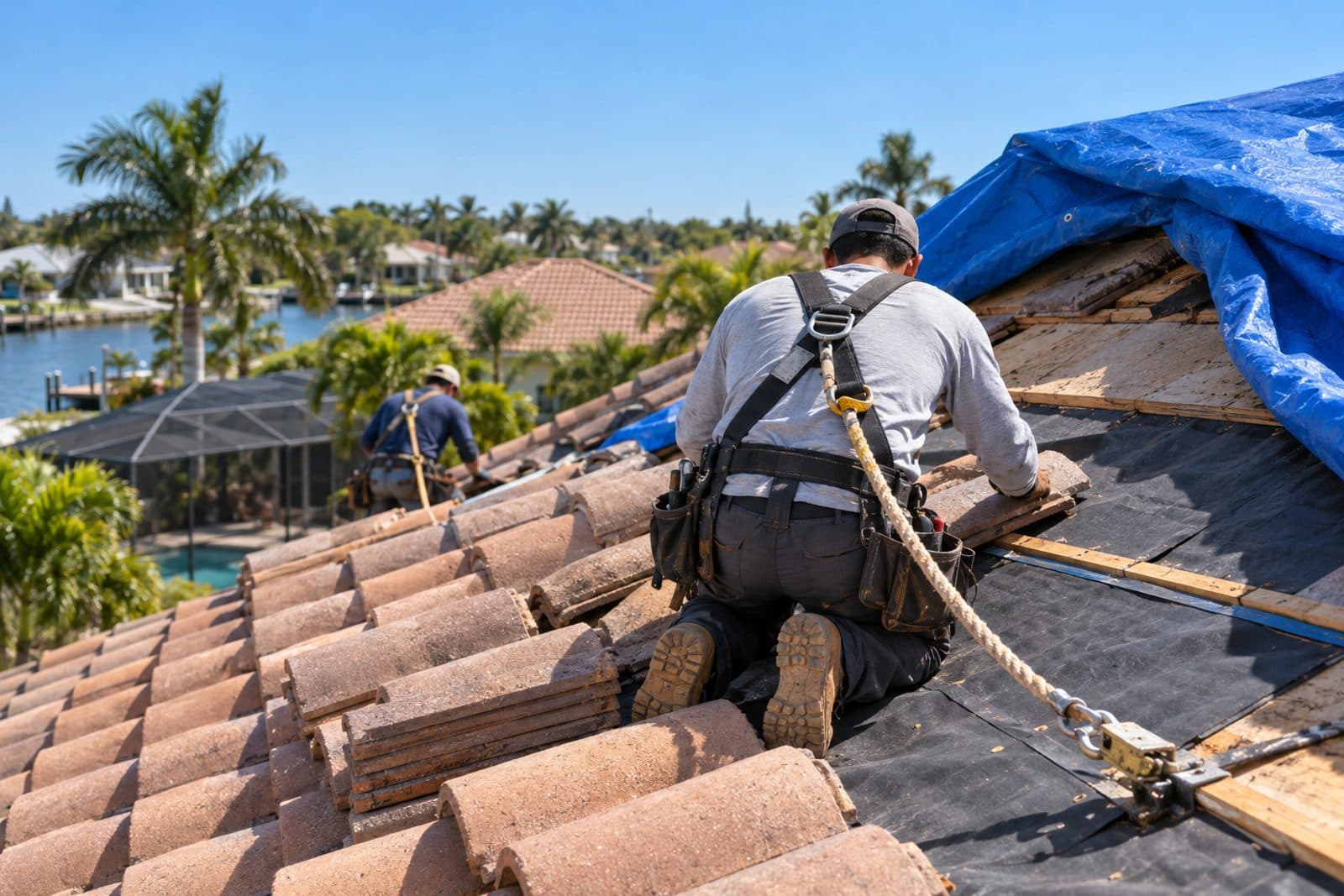
What the notice actually asks for depends on what was cited: missing or damaged shingles or tiles, a storm tarp still in place, active leaks, rotted decking or fascia, or a re-roof that was done without a permit. If the citation points to unpermitted roof work, correcting it usually means an after-the-fact permit and inspections, not only patching what is visible.
How the process works
The notice identifies the violation, the property and a reasonable time to correct it. If the condition is not corrected, the case is generally set for a hearing, and the board or magistrate issues an order with its own compliance date. A fine may be imposed for each day a violation continues past that date, and a certified copy of an order imposing a fine can be recorded in the public records, where it becomes a lien on the property. The exact steps, deadlines and amounts are stated on your notice and vary by city and county.
Most roof repairs and all re-roofs need a permit under section 105.1 of the Florida Building Code, issued by the city or county building department with jurisdiction over the property. Roofing products also have to be approved for where they are installed: inside the High-Velocity Hurricane Zone of Broward and Miami-Dade, that normally means a Miami-Dade Notice of Acceptance; elsewhere in Florida, Florida Product Approval or a local approval your building department accepts.
Tarps are a common reason for these notices. A tarp after a storm is meant to be temporary, and hurricane season runs June 1 through November 30, so tarps often outlast the repair window. Meanwhile a damaged roof keeps letting water into the structure. Keep people, children above all, away from any area under a failing roof, and do not walk on a damaged roof or attempt the repair yourself.
What you can check yourself
- Read the violation descriptionThe notice says what the officer saw — tarp, missing covering, leak, unpermitted work. That wording tells you whether this is a repair question, a permit question, or both.
- Note the compliance date and any hearing dateWrite both down and keep the notice where you can find it. Questions about those dates go to the code enforcement office named on the notice.
- Check the permit recordAsk your local building department whether a roof permit exists for the property and whether any permit is open or expired. An open permit stays on the record until it is properly closed out.
- Photograph the roof from the groundPictures from ground level, plus any interior water stains, help document the condition. Do not climb onto the roof to take them.
When to call us
Call when the citation involves work on the roof itself, or when a permit, an after-the-fact permit or a closed-out inspection is part of what the notice asks for. Have the notice, any order you have received, and your photos ready when you call.
We give a free estimate: we read the notice with you, look at the property, tell you what work the violation calls for, and agree the price in writing before any work starts. We are a contractor, not a law firm — we do not represent owners at hearings or discuss fines or liens, and questions about your case go to the code enforcement office named on your notice. Call (954) 906-7864 or send a request through the form on this website.
What we will do
- Read the citation and inspect the roofWe match what the officer wrote to what is actually on the roof, so the scope covers the cited condition rather than guesswork.
- Pull the permitWhere the work needs a permit we pull it under our licence, including an after-the-fact permit when roof work was already done without one.
- Do the repair or re-roofWork is performed under our Florida Certified Roofing Contractor licence CCC1335340, using roofing products approved for the area — a Miami-Dade Notice of Acceptance in the HVHZ, Florida Product Approval elsewhere.
- Schedule inspections and close outWe schedule the inspections, work to get the permit closed out, and give you the paperwork to show the code office named on your notice.
Work by 360 Home Improvements, Florida Certified Roofing Contractor CCC1335340 · Certified Building Contractor CBC1267336. Electrical, plumbing and AC work goes to our Florida-licensed subcontractors, who pull that trade's permit.
Related questions
- Does a notice mean I already owe a fine?
- A notice of violation generally sets a time to correct the problem rather than imposing a fine on its own. Fines usually come later, through an order with its own compliance date. What applies in your case is on your notice, and the code enforcement office named there can confirm it.
- Can I just replace the tarp instead?
- A tarp is a temporary cover, and a notice about a tarp is usually asking for the permanent repair. Leaving one up longer keeps water working into the decking and framing below.
- What if the old roof was replaced without a permit?
- Work already done without a permit generally has to be permitted after the fact, which can involve drawings, inspections and sometimes opening up finished surfaces so the work can be seen. Your local building department can tell you what it requires.
- What drives the cost of this work?
- The scope of the cited damage, whether a permit or an after-the-fact permit and drawings are needed, whether finished work has to be opened up for inspection, the roofing materials and their required approval, and whether any licensed trade work is involved. We look at the notice and the property first and give a free estimate, with the price agreed before work starts.
- Do you work outside my county?
- We work throughout Florida; our state certification is valid in every Florida county. Permits are still issued by the city or county building department with jurisdiction over the property.
This page is general information about Florida code enforcement, not legal advice. For questions about your own case (deadlines, hearing dates, fines or liens), contact the code enforcement office named on your notice, or a Florida attorney.
Send us the notice
Free estimate. The price is agreed before the work starts.
Or send us your notice details
Tell us what the notice says and where the property is, and we'll get back to you about the work it needs.
Code Violation Solver is run by 360 Home Improvements, a licensed Florida contractor. We fix the condition behind the violation; the code office named on your notice decides the case.