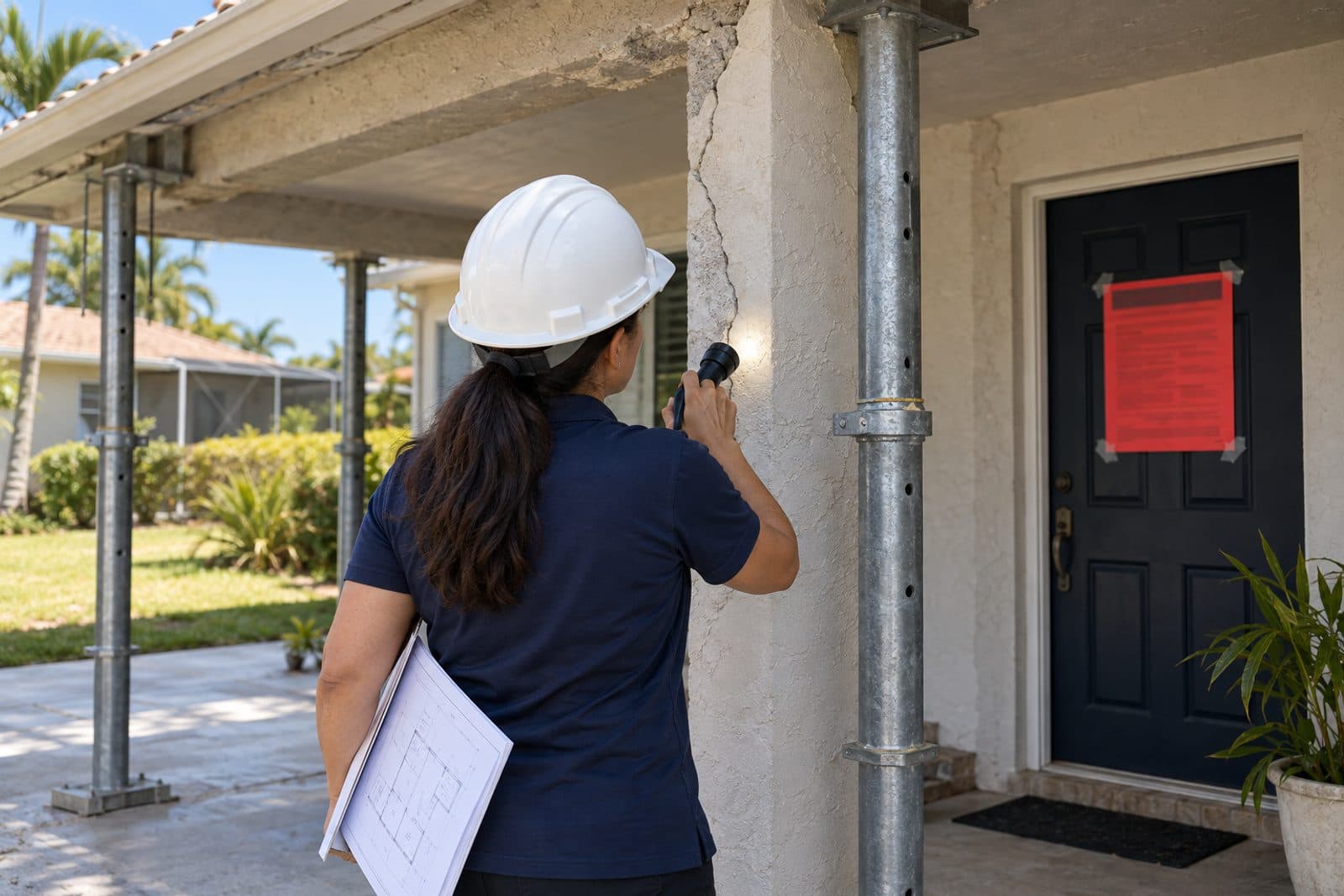
Keep people clear of the damaged area
Unsafe structure or building in disrepair
An unsafe-structure notice means the building official or code officer saw something they believe could fail. Keep people away from the area first. Correcting it usually means an engineer's assessment, a permit, the repair or demolition, and the inspections that close it out.
General information, not legal advice. Your notice and your city's code office have the final word.
Free estimate · 360 Home Improvements, Certified Building Contractor CBC1267336
Before anything else, please don't
- Don't let anyone use the damaged area. Keep people, cars and pets out from under it and off it.
- Don't remove a notice the city has posted on the building.
- Don't let structural repairs start without a permit and, where needed, an engineer's drawings. Structural work has to pass inspection to close the case.
- Don't miss the hearing or the compliance date. If the repair needs engineering first, tell the code office what is under way.
Why this gets cited
- Storm damage to a roof, wall, carport or porch that was never repaired.
- Rotted framing, termite damage or rusted steel that has weakened part of the building.
- Spalling concrete: cracked, flaking concrete with rusting rebar showing on balconies, columns or walkways.
- Railings, stairs or balconies that are loose, missing or failing.
- A vacant or fire-damaged building left open or partly collapsed.
- For condominium and co-op buildings, findings from a milestone inspection that call for repairs.
How we resolve it
- First, the area is made safe: people kept out, and shoring or bracing put in where it is needed.
- Where the city or the repair calls for one, a Florida-licensed engineer assesses the damage and prepares repair drawings, and we build to them.
- We pull the permit for the repair or, where the structure cannot be saved, for demolition.
- We repair or replace the damaged structure: framing, concrete, railings, walls.
- We pass the inspections, and the building official or code office is asked to re-inspect and close the case.
Who does the work
360 Home Improvements does the repair, or the demolition where it comes to that, under its Certified Building Contractor license (CBC1267336), working from a Florida-licensed engineer's drawings where they are needed. Electrical, plumbing and AC work goes to our Florida-licensed subcontractors, who pull that trade's permit. If a building or a repair is outside what our license covers, we tell you so at the estimate.
Certified Building Contractor CBC1267336. Look it up on the Florida DBPR license search.
The Florida angle
Salt air, heat and humidity work on concrete and steel along Florida's coasts, and spalling balconies and walkways show up in many older coastal buildings. Under section 553.899 of the Florida Statutes, condominium and cooperative buildings three stories or taller need milestone inspections, and the findings can lead to required repairs. Storm season adds wind and water damage to carports, porches and roofs across the state.
Free tools for this
- Florida Building Code lookupWhich part of the Florida Building Code covers my job?Pick the job — re-roof, roof repair, windows, shutters, fence, shed, pool, AC, water heater, electrical, remodel, garage conversion, addition and more — and see which book of the Florida Building Code, 8th Edition (2023), governs it, the chapters and sections to look at in plain English, free links to the official text, the extra Broward and Miami-Dade sections, and whether it usually needs a permit.Open →
- Notice decoderWhat does my notice mean?Tick the words you can see on your letter — notice of violation, compliance date, hearing, order imposing fine, lien — and get each one in plain English, where you likely are on the usual Florida timeline, and a next-steps checklist.Open →
- Deadline checkerHow many days do I have?Enter the date on your notice and the days to correct, or the compliance date, and get the days left, a dated plan to get it corrected in time, a printable copy and a calendar file.Open →
- Proof-of-compliance photo guideWhat photos prove it's fixed?Pick the violation on your notice and get a shot list for before, during and after the work — the wide shot with the house number, the inspector's angles, close-ups, the permit card and the final inspection — plus a printable photo card to hold in the first frame.Open →
- Contractor license guideWhich licensed contractor fixes this?Tick the work your notice calls for — roof, structure, electrical, plumbing, AC, pool, fence or lot clean-up — and see the Florida license that usually does it, the DBPR codes to look for, who pulls each permit, and how to check a license.Open →
Questions people ask
- Is it safe to stay in the house?
- Follow the notice. If it says the building or part of it must not be occupied, keep everyone out. If it does not say, ask the building official or code office named on the notice which areas to keep clear of, and keep people out of the damaged area in the meantime.
- Do I need an engineer?
- Often, for structural repairs. Many building departments want an engineer's assessment and drawings before they issue the permit. We will tell you whether yours does.
- What is a milestone inspection?
- A structural inspection required under section 553.899 of the Florida Statutes for condominium and cooperative buildings three stories or taller. The repairs it identifies are usually done by a licensed contractor whose license covers that building, working from an engineer's drawings.
- Repair or demolish?
- That depends on the damage, the building and your plans for it. We and the engineer can lay out both options; the building official approves the permit for whichever you choose.
General information, not legal advice. Your notice and your city's code office have the final word.
Get a free estimate
Tell us what the notice says and where the property is. We look at the violation, explain the work, the permits and the inspections, and give you the price before anything starts.
Keep the notice handy: the case number, the violation cited and the compliance date tell us what the city needs to see.
Find your city
Find your county's code office — the office named on your notice is the one to ask about deadlines, hearings, fines and liens.
A different kind of violation?
- A lien was recorded on my property
- Daily fines are adding up
- Work done without a permit
- Open or expired permits
- Overgrown lot, yard or debris
- Roof citation
- Fence, wall or pool barrier citation
Code Violation Solver is run by 360 Home Improvements. We fix the violation and get it permitted and inspected; closing the case, and anything to do with fines or liens, is up to the city.