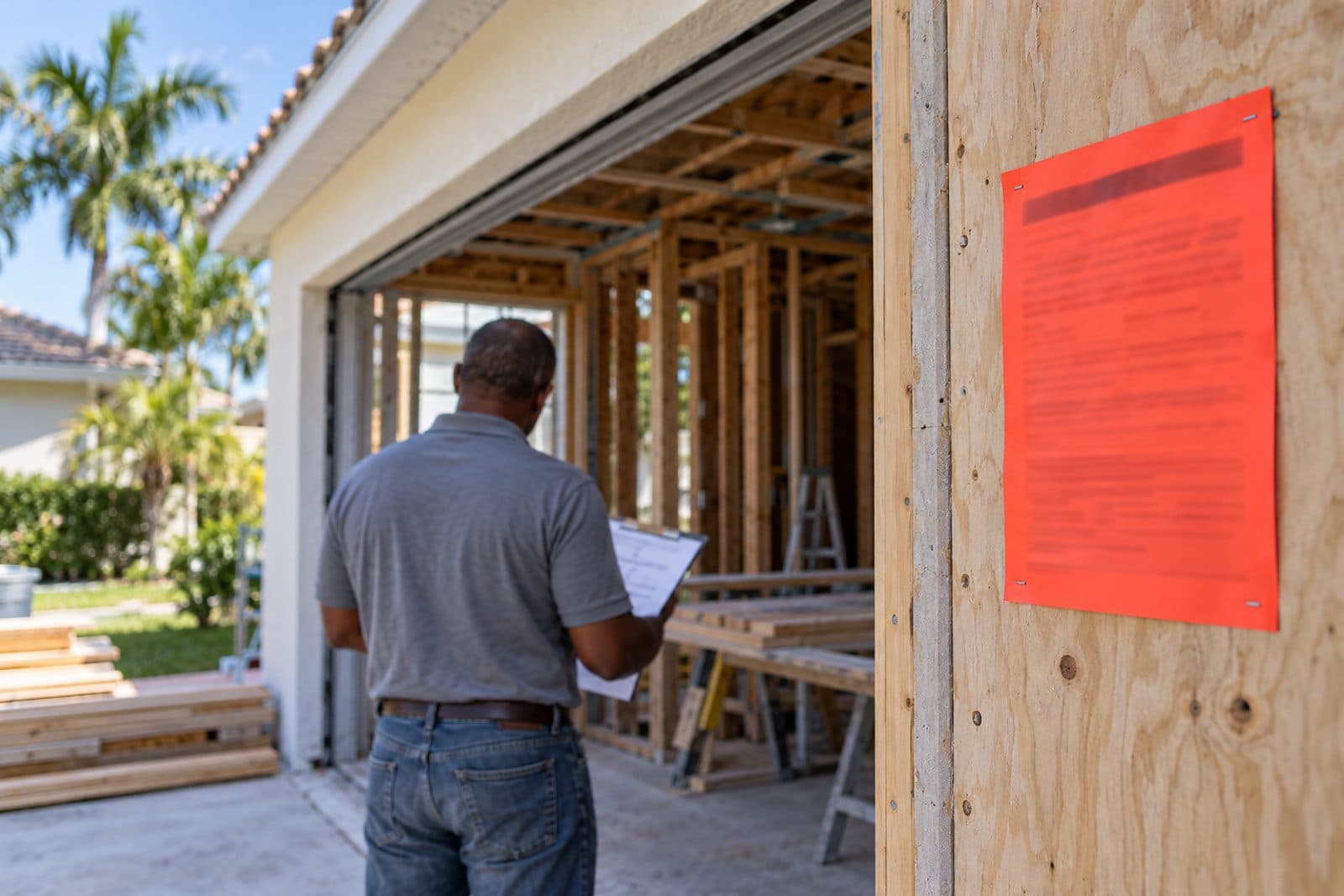
The city says work was done without a permit
Under section 105.1 of the Florida Building Code, most construction, alteration and repair work needs a permit before it starts. When the city finds work done without one, the usual path is an after-the-fact permit: drawings where needed, inspections, and corrections until the work passes, or removal where it cannot be permitted.
General information, not legal advice. Your notice and your city's code office have the final word.
Free estimate · 360 Home Improvements, Certified Building Contractor CBC1267336
Before anything else, please don't
- Don't hire unlicensed help to fix an unpermitted-work violation. The city needs to see permitted, inspected work, and more unpermitted work adds to the case.
- Don't tear the work out before talking to us and the code office. Removal can be the right answer, but in many cities it needs a permit of its own.
- Don't miss the compliance date. If the permit process will run past it, tell the code office before the date.
Why this gets cited
- A previous owner enclosed a porch, converted a garage or added a room, and no permit was pulled.
- The work was done by someone who did not pull a permit for it.
- Windows, doors, a water heater or an AC unit were replaced without the permit the job needed.
- A sale inspection, a permit search or a neighbor's report showed work that does not match the city's records.
- A permit was applied for but never issued, and the work went ahead anyway.
- A shed, deck, fence or pool was added without checking whether the city requires a permit for it.
How we resolve it
- We compare what was built with what the city's records show, and tell you whether it looks permittable as it is, needs changes, or should come out. The building department makes the call.
- We prepare the after-the-fact permit application, with drawings, and engineering where the building department asks for it.
- We open up walls, ceilings or finishes where the inspector needs to see framing, wiring or plumbing that is now covered, and close them up after.
- We correct what does not meet code, or remove the work and restore the area where it cannot be permitted.
- Electrical, plumbing or AC work in the project goes to our Florida-licensed subcontractor in that trade, who pulls that trade's permit.
- We take each inspection through to final, then the code office is asked to re-inspect and close the violation.
Who does the work
360 Home Improvements applies for the building permit under its Certified Building Contractor license (CBC1267336). Electrical, plumbing and AC work in the same project goes to our Florida-licensed subcontractors, who pull that trade's permit.
Certified Building Contractor CBC1267336. Look it up on the Florida DBPR license search.
The Florida angle
Each Florida county and city building department enforces the Florida Building Code, and section 105.1 requires a permit before most work starts. In Broward and Miami-Dade, the High-Velocity Hurricane Zone adds a layer: windows, doors, shutters and roofing must carry a product approval for that zone, so an unpermitted window or door swap there usually needs the approval paperwork as well as the permit. What is exempt from a permit varies by jurisdiction, so the building department has the final word.
Free tools for this
- Permit checkerDo I need a permit?Pick the job — fence, shed, re-roof, roof repair, water heater, AC change-out, windows, garage conversion, kitchen or bath remodel, generator and more — and see whether it usually needs a permit under the Florida Building Code, why, who pulls it, and what changes in Broward and Miami-Dade.Open →
- Florida Building Code lookupWhich part of the Florida Building Code covers my job?Pick the job — re-roof, roof repair, windows, shutters, fence, shed, pool, AC, water heater, electrical, remodel, garage conversion, addition and more — and see which book of the Florida Building Code, 8th Edition (2023), governs it, the chapters and sections to look at in plain English, free links to the official text, the extra Broward and Miami-Dade sections, and whether it usually needs a permit.Open →
- After-the-fact permit checklistHow do I permit work that's already done?A step-by-step checklist for work done without a permit: gather what exists, a licensed contractor's assessment, drawings, the application, inspections that may mean opening walls or ceilings, corrections, final inspection, then closing the code case and keeping the records. Tick as you go and print it.Open →
- Notice decoderWhat does my notice mean?Tick the words you can see on your letter — notice of violation, compliance date, hearing, order imposing fine, lien — and get each one in plain English, where you likely are on the usual Florida timeline, and a next-steps checklist.Open →
- Deadline checkerHow many days do I have?Enter the date on your notice and the days to correct, or the compliance date, and get the days left, a dated plan to get it corrected in time, a printable copy and a calendar file.Open →
- Proof-of-compliance photo guideWhat photos prove it's fixed?Pick the violation on your notice and get a shot list for before, during and after the work — the wide shot with the house number, the inspector's angles, close-ups, the permit card and the final inspection — plus a printable photo card to hold in the first frame.Open →
- Contractor license guideWhich licensed contractor fixes this?Tick the work your notice calls for — roof, structure, electrical, plumbing, AC, pool, fence or lot clean-up — and see the Florida license that usually does it, the DBPR codes to look for, who pulls each permit, and how to check a license.Open →
Questions people ask
- What is an after-the-fact permit?
- A permit applied for after the work is already done. The building department reviews the work as built, usually from drawings, and inspects it. It may ask for parts to be opened up so covered work can be seen, and for corrections where the work does not meet code.
- Will I have to tear it out?
- Not necessarily. A lot of unpermitted work can be permitted after the fact, sometimes with corrections. Some cannot, and then removal is the path. We will tell you which looks likely once we have seen it; the building department decides.
- The work was done before I bought the house. Is it still my problem?
- In most cases the city works with the current owner, whoever did the work. For questions about the seller or the sale, talk to a Florida attorney.
- Who deals with the building department?
- We do, for the permit: we apply, schedule the inspections and meet the inspector. Closing the code case is usually the owner's request to the code office, and the final inspection is what it is closed on.
General information, not legal advice. Your notice and your city's code office have the final word.
Get a free estimate
Tell us what the notice says and where the property is. We look at the violation, explain the work, the permits and the inspections, and give you the price before anything starts.
Keep the notice handy: the case number, the violation cited and the compliance date tell us what the city needs to see.
Find your city
Florida: Jacksonville
Find your county's code office — the office named on your notice is the one to ask about deadlines, hearings, fines and liens.
A different kind of violation?
- A lien was recorded on my property
- Daily fines are adding up
- Open or expired permits
- Overgrown lot, yard or debris
- Roof citation
- Fence, wall or pool barrier citation
- Unsafe structure or building in disrepair
Code Violation Solver is run by 360 Home Improvements. We fix the violation and get it permitted and inspected; closing the case, and anything to do with fines or liens, is up to the city.