Work done without a permit in Tampa, FL
A notice about unpermitted work means someone has identified construction, alteration or repair on the property that has no permit on record. It may be a garage that was enclosed, a patio turned into a room, an addition, replaced windows or doors, or electrical or plumbing changes. It may have been done by a previous owner; that does not matter, because the record stays with the property. Read the notice all the way through first. Write down the compliance date and any hearing date on it, and note the office and case number printed on it. Questions about your own case — the deadline, the hearing, any fines or a lien — go to the code enforcement office named on that notice. Legal questions go to a Florida attorney.
Call us or send your notice details · free estimate
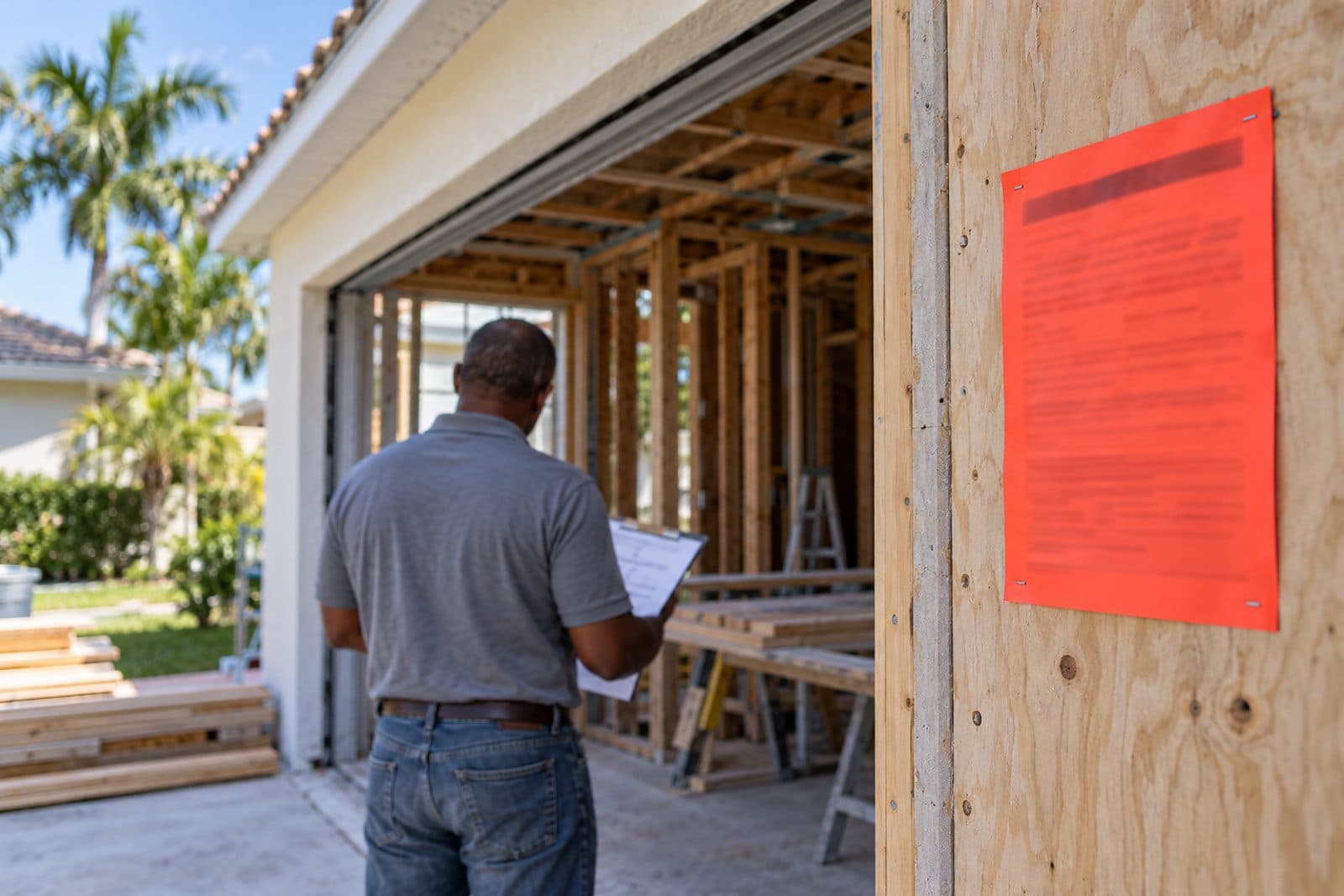
Tampa is an incorporated municipality, so code enforcement here is normally run by the city itself, though some municipalities contract it out; the notice names the office handling your case. Across Florida, code enforcement runs under Chapter 162, Florida Statutes, which lets a city or county use a code enforcement board or a special magistrate. The process generally starts with a notice of violation that identifies the problem and gives a reasonable time to correct it, and if it is not corrected the case is set for a hearing. The board or magistrate then issues an order with a compliance date, and a fine may be imposed for each day the violation continues past that date. A certified copy of an order imposing a fine can be recorded in the public records, where it becomes a lien on the property. The exact steps, deadlines and amounts vary by city and county and are stated on your notice, so confirm them with the office named there.
While your case is open, don't
- Do not start more work before the permit is issued. Under section 105.1 of the Florida Building Code a permit is required for most construction, alteration and repair, and adding unpermitted work on top of unpermitted work makes the file harder to sort out.
- Do not let the compliance or hearing date slip past unnoticed. Those dates are printed on the notice for a reason, and only the code office named on it can tell you how they apply to your case.
- Do not tear out the work before the building department says what it wants. The building department decides what can stay, what must be opened up and what has to come out, and demolishing first can remove the evidence an inspector needs to see.
- Do not assume a closed-looking job is clear. An open or expired permit from an earlier job stays on the property record until it is properly closed out, so the status is worth checking with the local building department.
What we do
- We read the notice with you and look at the workWe go out to the property, look at what was cited — the enclosed garage, the converted room, the added bathroom, the replaced windows — and tell you plainly what the violation needs. The estimate is free and the price is agreed in writing before work starts.
- We check the permit historyWe look at what the property record shows for the work in question and for any open or expired permits sitting on the file. That tells us whether we are chasing an after-the-fact permit, a close-out, or both.
- We prepare drawings and apply for the after-the-fact permitWhere the building department needs drawings, we have them prepared. We apply under our Florida Certified Building Contractor licence CBC1267336.
- We open up finished surfaces where an inspector has to see behind themAn after-the-fact permit can mean opening walls or ceilings so framing, wiring or plumbing can be inspected. It is the building department, not us, that decides what must be opened.
- We do the construction workWe bring the work up to the Florida Building Code, or take it out where it cannot be kept. Electrical, plumbing and air-conditioning portions are done by our Florida-licensed subcontractors, who pull that trade's permit.
- We carry it through inspections and hand you the paperworkWe schedule the inspections and work to get the permit closed out, then give you the documents to show the code office named on your notice.
Work by 360 Home Improvements, Florida Certified Building Contractor CBC1267336. Electrical, plumbing and AC work goes to our Florida-licensed subcontractors, who pull that trade's permit.
How it works in Tampa
Tampa's housing stock runs from 1920s bungalows in Hyde Park, Tampa Heights and Seminole Heights to mid-century concrete block and stucco homes and large volumes of newer construction in New Tampa and the outer suburbs. Older bungalows near the urban core often have detached garages or carports and decades of changes layered on by different owners, while post-1990 subdivisions come with HOAs and attached garages. Garage conversions, enclosed porches and patios, and replaced windows, doors and roofs are the kinds of work that need a permit and that can be seen from the street, which is why they turn up in notices.
The Florida Building Code sets wind-load requirements statewide, and products and assemblies must be approved for the conditions where they are installed; outside the High-Velocity Hurricane Zone, which is Broward and Miami-Dade, products typically carry Florida Product Approval or a local approval, and your building department can confirm what it accepts. That matters in Tampa, where hurricane season runs June 1 through November 30 and coastal exposure drives wind-load requirements on items like garage doors. Salt air off Tampa Bay and near-constant humidity also speed up corrosion on metal hardware in South Tampa and other waterfront areas, so work that was done quickly after a storm and never permitted often needs attention to materials as well as paperwork. We work anywhere in Florida — the CBC1267336 state certification is valid in every Florida county, and it is verifiable on the Florida DBPR website.
Questions people ask
- The work was done before I bought the house. Is that different?
- Not for the property record. Work a previous owner did without a permit stays with the property, and the building department treats it the same way. What that means for your case is a question for the code office named on your notice.
- Will walls have to be opened?
- Sometimes. An after-the-fact permit can mean opening walls or ceilings so an inspector can see framing, wiring or plumbing behind the finish. The building department decides what has to be opened, not the contractor.
- Who handles code enforcement in Tampa?
- Tampa is an incorporated municipality, so code enforcement is normally run by the municipality itself, though some contract it out. The office handling your case is named on the notice, and that is who to call about deadlines, hearings, fines or a lien.
- What does it cost to fix unpermitted work in Tampa?
- It depends on what was built, whether drawings are needed, how much finished surface has to be opened, whether electrical, plumbing or AC trades are involved, and whether any of it has to come out. We look at the property and give you a free estimate, and the price is agreed in writing before work starts.
- Can you make the fines stop?
- No. Fines, liens, hearings and appeals are decided by the code enforcement board, special magistrate or local government named on the notice. We are a contractor, not a law firm: we do the work and the permitting, and we do not represent owners at hearings.
This page is general information about Florida code enforcement, not legal advice. For questions about your own case (deadlines, hearing dates, fines or liens), contact the code enforcement office named on your notice, or a Florida attorney.
Send us the notice
Call (954) 906-7864 or send a request through the form on this website for a free estimate; we look at the work, tell you what it needs and agree the price in writing before anything starts. Questions about the case itself — your compliance date, a hearing, fines or a lien — go to the code enforcement office named on your notice.
Request a free estimate
Tell us what the notice says and where the property is. We'll look at what the violation needs and agree the price with you before any work starts.
Same violation in nearby cities
Other violations in Tampa
Code Violation Solver is run by 360 Home Improvements, a licensed Florida contractor. We fix the condition behind the violation; the code office named on your notice decides the case.