What does it mean when I get a notice saying my lot is overgrown?
It means the code office that inspected the property found grass, weeds, brush or debris that exceeds what the local property-maintenance ordinance allows, and it is asking you to correct the condition by the date printed on the notice. The notice itself is not a fine; it identifies the problem and gives you a reasonable time to fix it before the case moves forward.
Call us or send your notice details · free estimate
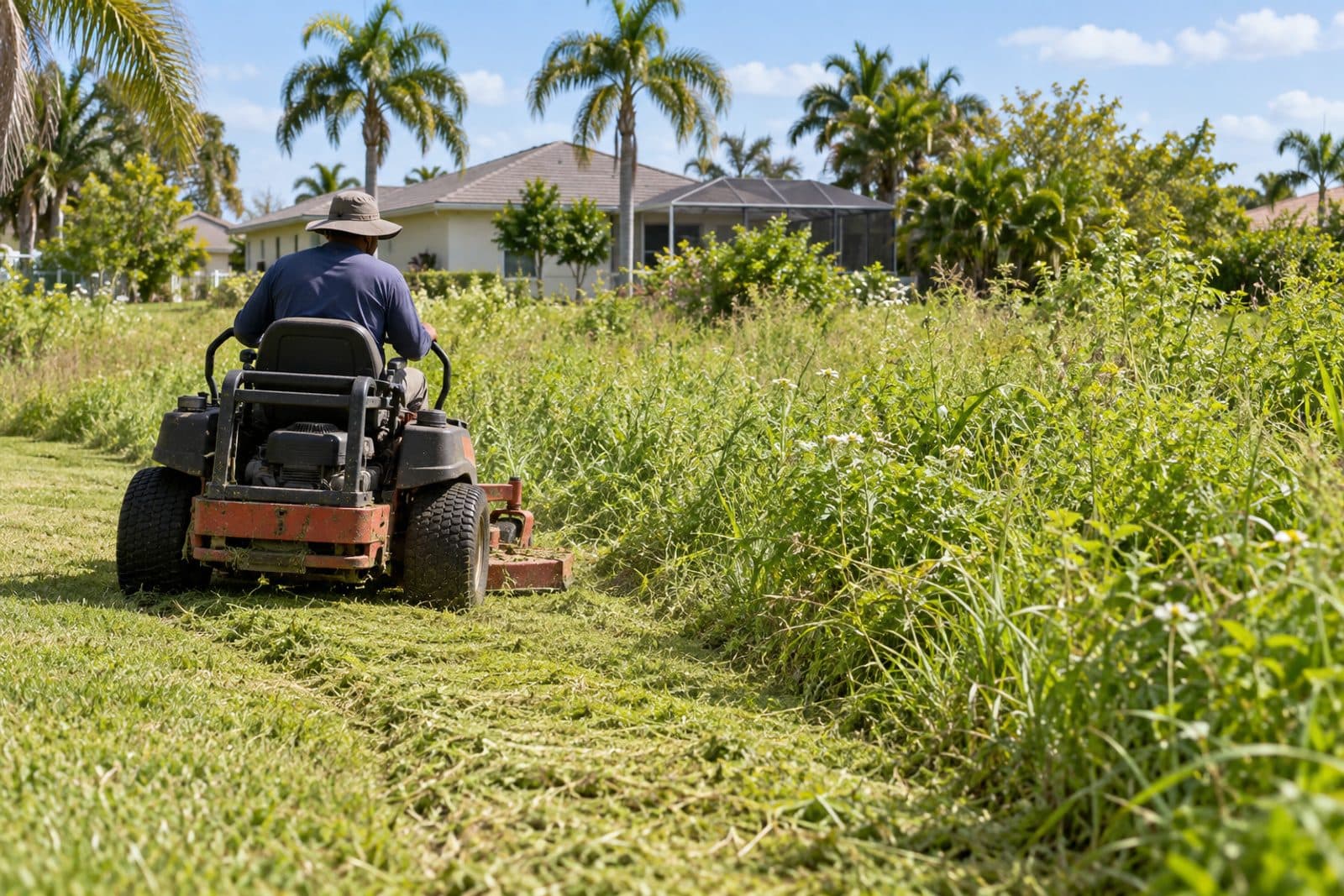
What matters next is the paperwork in your hand. Overgrown lots, junk, trash and debris are governed by local ordinances adopted by each city or county rather than one statewide rule, so the exact standard, the deadline and any next step are stated on your notice and vary by city and county. Questions about your own case — the compliance date, a hearing date, fines or liens — go to the code enforcement office named on the notice, and legal questions go to a Florida attorney.
How the process generally works
In Florida, code enforcement is handled locally under Chapter 162, Florida Statutes, which lets cities and counties use either a code enforcement board or a special magistrate. The usual sequence is a notice of violation that describes the problem and gives time to correct it; if the condition is still there, the case is set for a hearing, and the board or magistrate issues an order with a compliance date. A fine may be imposed for each day a violation continues past that date, and a certified copy of an order imposing a fine can be recorded in the public records, where it becomes a lien on the property.
Overgrowth cases have one extra feature worth knowing. Many local governments can, after giving notice, mow an overgrown lot or clear debris themselves and then bill the owner or record a lien for the cost. Your local ordinance and your notice set out whether and how that applies.
Florida's long, wet growing season lets a yard or vacant lot overgrow quickly, and storm debris left after hurricane season — which runs June 1 through November 30 — is a frequent reason for these notices. The compliance deadline on a notice still applies as written, whatever the weather has been.
What you can check yourself
- The exact condition citedRead the violation description and the ordinance section quoted on the notice. It usually names a specific condition — grass height, weeds, brush, trash, construction or storm debris — rather than general untidiness.
- The compliance date and any hearing dateWrite both dates down where you will see them. If anything on the notice is unclear, the code office named on it is the place to ask.
- The full property lineWalk the boundary if it is safe to do so. Swales, alley strips and the area behind a fence are often included in what an inspector looks at.
- Hidden hazards in the growthThick growth and debris piles can hide holes, sharp material and wildlife, so do not wade into heavy brush. Keep children and pets away from the area until it is cleared.
- Standing water and a neglected poolNote any standing water, a green or untreated pool, or containers holding water. These are commonly cited alongside overgrowth.
When to call us
Call when the clearing is beyond hand tools — heavy brush, vines into the structure, large debris piles, construction or storm debris needing hauling and disposal, or a neglected pool. Have the notice, any order, and photos of the property ready; we read the notice with you, look at the property and give a free estimate, and the price is agreed in writing before work starts. If any part of the work turns out to need a permit, we pull it under our Florida Certified Building Contractor licence CBC1267336.
We are a contractor, not a law firm. We do not represent owners at hearings and we do not negotiate fines or liens — those are decided by the board, magistrate or local government named on your notice, and that office is where case questions belong. To reach us, call (954) 906-7864 or send a request through the form on this site.
What we will do
- Clear and mow the lotWe cut down the overgrowth across the cited area and mow the lot back to a maintained condition.
- Cut back growth from the structureWe cut overgrowth and vines back from the house, fences and sidewalks so the building envelope and walkways are clear.
- Haul away debrisJunk, trash, construction and storm debris are removed from the property and disposed of.
- Address standing water and a neglected poolWe deal with standing water on the lot and with a neglected pool as part of the clean-up scope.
- Before-and-after photographsWe document the work so you have something to show the code office named on your notice.
Work by 360 Home Improvements, Florida Certified Building Contractor CBC1267336. Electrical, plumbing and AC work goes to our Florida-licensed subcontractors, who pull that trade's permit.
Related questions
- Does an overgrown lot notice mean I already owe a fine?
- A notice of violation is generally the first step and gives time to correct the condition; a fine typically follows an order after a hearing, for each day a violation continues past the compliance date. The amounts, steps and timing vary by city and county. Only the code office named on your notice can tell you where your case stands.
- The lot is vacant and I do not live nearby — does that change anything?
- The condition of the property is what is cited, not whether anyone lives there. Vacant lots overgrow fast in Florida's growing season and are a common source of notices. The deadline on the notice applies the same way.
- Do I need a permit to clear an overgrown lot?
- Routine mowing, brush cutting and debris removal normally do not involve a building permit. If the work extends into repairs or construction, the Florida Building Code (section 105.1) requires a permit for most such work, issued by the city or county building department with jurisdiction. Your local building department can confirm what applies.
- What drives the cost of clearing an overgrown lot?
- The main factors are the size of the area and how heavy the growth is, the volume and type of debris to be hauled and disposed of, access for equipment, whether a pool or standing water is involved, and whether any part of the work needs a permit or licensed trade work. We give a free estimate after reading the notice and looking at the property, and work starts only once you agree the price.
This page is general information about Florida code enforcement, not legal advice. For questions about your own case (deadlines, hearing dates, fines or liens), contact the code enforcement office named on your notice, or a Florida attorney.
Send us the notice
Free estimate. The price is agreed before the work starts.
Keep reading
- The violationOvergrown lot, yard or debris
- AnswerWhat does it mean when a permit on my property is still open?
- AnswerWhat does it mean when I get cited for unpermitted work in Florida?
- AnswerWhat does it mean when a code violation fine runs every day in Florida?
- Every code violation question we have answered
Or send us your notice details
Tell us what the notice says and where the property is, and we'll get back to you about the work it needs.
Code Violation Solver is run by 360 Home Improvements, a licensed Florida contractor. We fix the condition behind the violation; the code office named on your notice decides the case.