Roof citation in Miami, FL
A roof citation means a code officer looked at the property and wrote up what they saw. Common ones are missing or damaged roofing, a tarp still up months after a storm, visible leaks, rotted decking or fascia, or a re-roof that was done without a permit. First, read the notice all the way through. Note the compliance date, note any hearing date, and note the office and case number printed on it. Questions about your own case — the deadline, the hearing, any fine or lien — go to that code office. Legal questions go to a Florida attorney. Then the practical part begins: the condition on the roof has to be corrected, and most roof work needs a permit.
Call us or send your notice details · free estimate
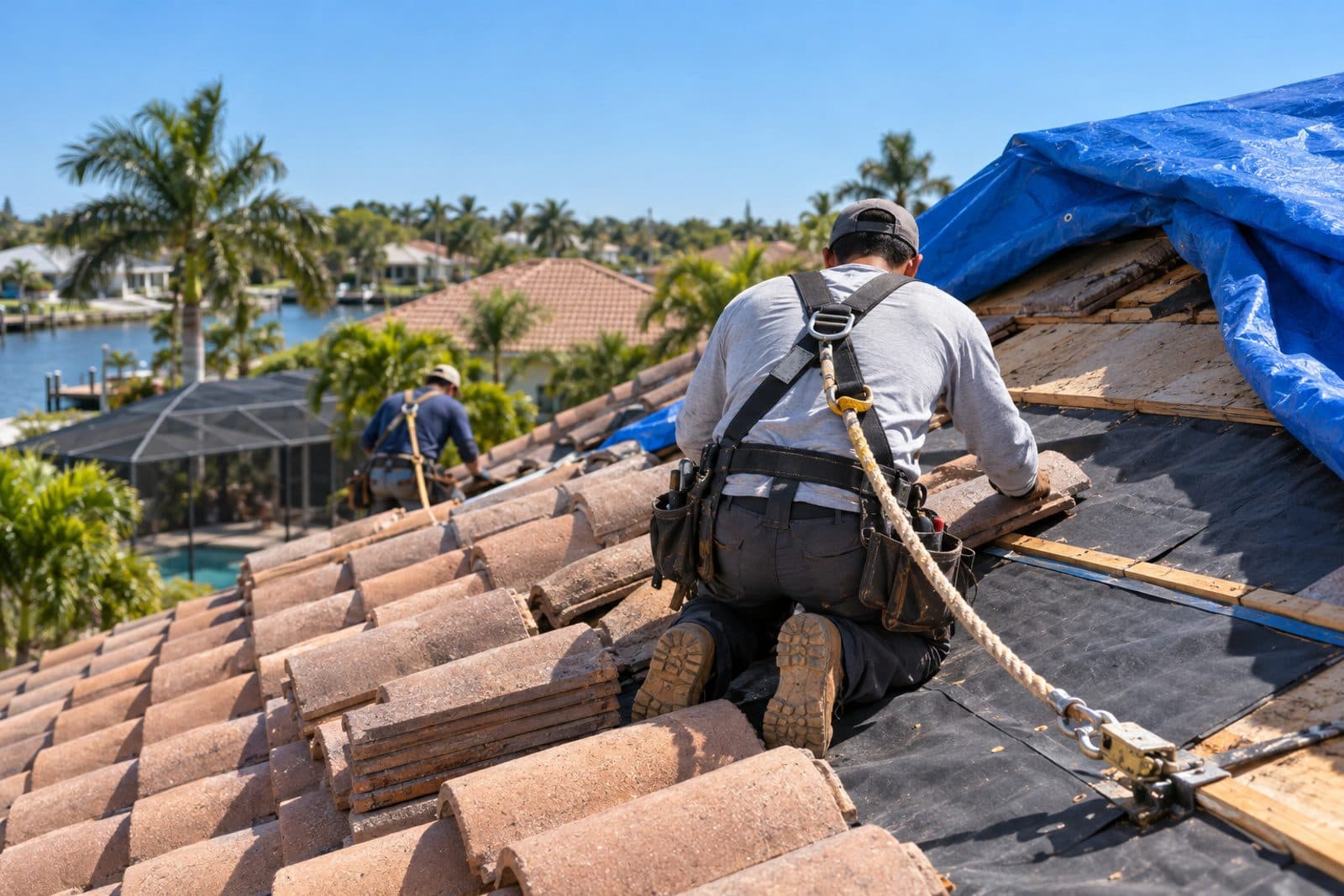
Miami is an incorporated municipality, so code enforcement is normally run by the municipality itself, though some places contract it out. The notice names the office handling your case. Across Florida, code enforcement runs under Chapter 162, Florida Statutes, which lets a city or county use a code enforcement board or a special magistrate. The process generally starts with a notice of violation giving a reasonable time to correct the problem. If it is not corrected, the case is set for a hearing, and the board or magistrate issues an order with a compliance date. A fine may be imposed for each day a violation continues past that date, and a certified copy of an order imposing a fine can be recorded in the public records, where it becomes a lien on the property. The exact steps, dates and amounts vary by city and county and are stated on your notice, so confirm them with the office named there.
While your case is open, don't
- Do not walk on the roof. A damaged roof is not safe to stand on, so keep people and children away from the area below and around it and do not attempt the repair yourself.
- Do not start the work before the permit is in place. Most roof repairs and every re-roof need a permit under the Florida Building Code, and work started without one usually has to be permitted after the fact.
- Do not let the compliance or hearing date slip past unnoticed. Those dates are printed on the notice for a reason, and only the code office named on it can tell you what applies in your case.
- Do not tear out roofing or decking before the building department says what it needs. On an after-the-fact permit the department may want to see the existing work, and opening things up in the wrong order can mean doing it twice.
- Do not assume a tarp counts as a fix. A tarp put up after a storm is meant to be temporary, and water keeps working into the structure while it sits there.
What we do
- We read the notice with youWe go through what the citation was written for — missing or damaged roofing, a tarp left up, leaks, rotted decking or fascia, or a re-roof done without a permit. That tells us what the code office is looking for.
- We inspect the roofWe look at the covering, the decking, the fascia and the areas where water has been getting in. Then we tell you what work the violation needs.
- We price it in writing firstThe estimate is free, and the price is agreed in writing before any work starts. Cost depends on the size of the roof, the roofing system, how much decking or fascia is rotted, access, and whether an after-the-fact permit is involved.
- We pull the permit under our licenceWork is done under our Florida Certified Roofing Contractor licence CCC1335340, alongside our Florida Certified Building Contractor licence CBC1267336. After-the-fact permits included, when that is what the building department requires.
- We do the repair or the re-roofWe use roofing products approved for the area. Miami is inside the High-Velocity Hurricane Zone, so products there normally carry a Miami-Dade Notice of Acceptance.
- We schedule inspections and work to get the permit closed outThen we hand you the paperwork so you can show the code office named on your notice what was done.
Work by 360 Home Improvements, Florida Certified Roofing Contractor CCC1335340 · Certified Building Contractor CBC1267336. Electrical, plumbing and AC work goes to our Florida-licensed subcontractors, who pull that trade's permit.
How it works in Miami
Miami sits in the High-Velocity Hurricane Zone with Broward and the rest of Miami-Dade. Roofing, windows, doors and shutters installed here need approval for that zone, usually a Miami-Dade Notice of Acceptance, while elsewhere in Florida products typically carry Florida Product Approval or a local approval. Your building department can confirm what it accepts. That matters on a roof violation because the fix has to be done with materials approved for where the property is, not just any material that sheds water.
Hurricane season runs June 1 through November 30, and storm damage left unrepaired — roofs still under tarps, downed fences, scattered debris — is a common source of code enforcement notices afterward. Miami's heat, humidity and salt air off Biscayne Bay are hard on a roof that has already been opened up, and the older inland neighborhoods are full of concrete block and stucco homes from the 1940s through the 1970s where decking and fascia are the first things to rot. Condominium and gated-community properties are common here too, so exterior work often needs HOA approval before anything goes on the roof. Whatever the property type, the deadline on the notice still applies as written.
Questions people ask
- Does a roof repair in Miami need a permit?
- The Florida Building Code, section 105.1, requires a permit for most construction, alteration and repair work, and re-roofing and most roof repairs fall under that. Permits are issued by the city or county building department with jurisdiction over the property. We pull the permit under our licence when the work needs one.
- The roof was already re-done without a permit. What now?
- Work already done without a permit generally has to be permitted after the fact. That can involve drawings, inspections, and opening up finished surfaces so the work can be inspected. We handle after-the-fact permits as part of the job.
- What roofing products can be used in Miami?
- Miami-Dade and Broward make up the High-Velocity Hurricane Zone, so roofing products installed here usually need a Miami-Dade Notice of Acceptance. We use products approved for the zone. The building department can confirm what it accepts for your property.
- Can you get my fine or lien dealt with?
- No. We are a contractor, not a law firm: we do not represent owners at hearings and we do not negotiate fines or liens. Fines, liens, hearings and appeals are decided by the code enforcement board, special magistrate or local government named on your notice, so ask that office, and take legal questions to a Florida attorney.
- There is an open or expired roof permit on the property. Does that matter?
- An open or expired permit stays on the property record until it is properly closed out. Check its status with the local building department. We schedule inspections and work to get permits we pull closed out.
This page is general information about Florida code enforcement, not legal advice. For questions about your own case (deadlines, hearing dates, fines or liens), contact the code enforcement office named on your notice, or a Florida attorney.
Send us the notice
The estimate is free: we read the notice with you, look at the roof, tell you what the violation needs and agree the price in writing before work starts. Call (954) 906-7864 or send a request through the form on this website — and for anything about the case itself, deadlines, hearings, fines or liens, contact the code office named on your notice.
Request a free estimate
Tell us what the notice says and where the property is. We'll look at what the violation needs and agree the price with you before any work starts.
Other violations in Miami
- Fence, wall or pool barrier citation
- Unsafe structure or building in disrepair
- A lien was recorded on my property
- Daily fines are adding up
- Work done without a permit
- Open or expired permits
- Overgrown lot, yard or debris
Code Violation Solver is run by 360 Home Improvements, a licensed Florida contractor. We fix the condition behind the violation; the code office named on your notice decides the case.