Keep people clear of the damaged area
Unsafe structure or building in disrepair in Miami, FL
An unsafe-structure notice means a building official looked at the property and found a condition that affects safety. It can be structural damage, rotted framing, spalling concrete, broken stairs, railings or balconies, fire or storm damage, or a building left open and unsecured. Read the notice first, all of it. Note what it says was found, the date you are given to correct it, and any hearing date. Then contact the code office named on the notice with any question about your own case. Keep everyone away from the affected area, children above all, and follow any instruction the building official gives you. Do not try structural or roof repairs yourself.
Call us or send your notice details · free estimate
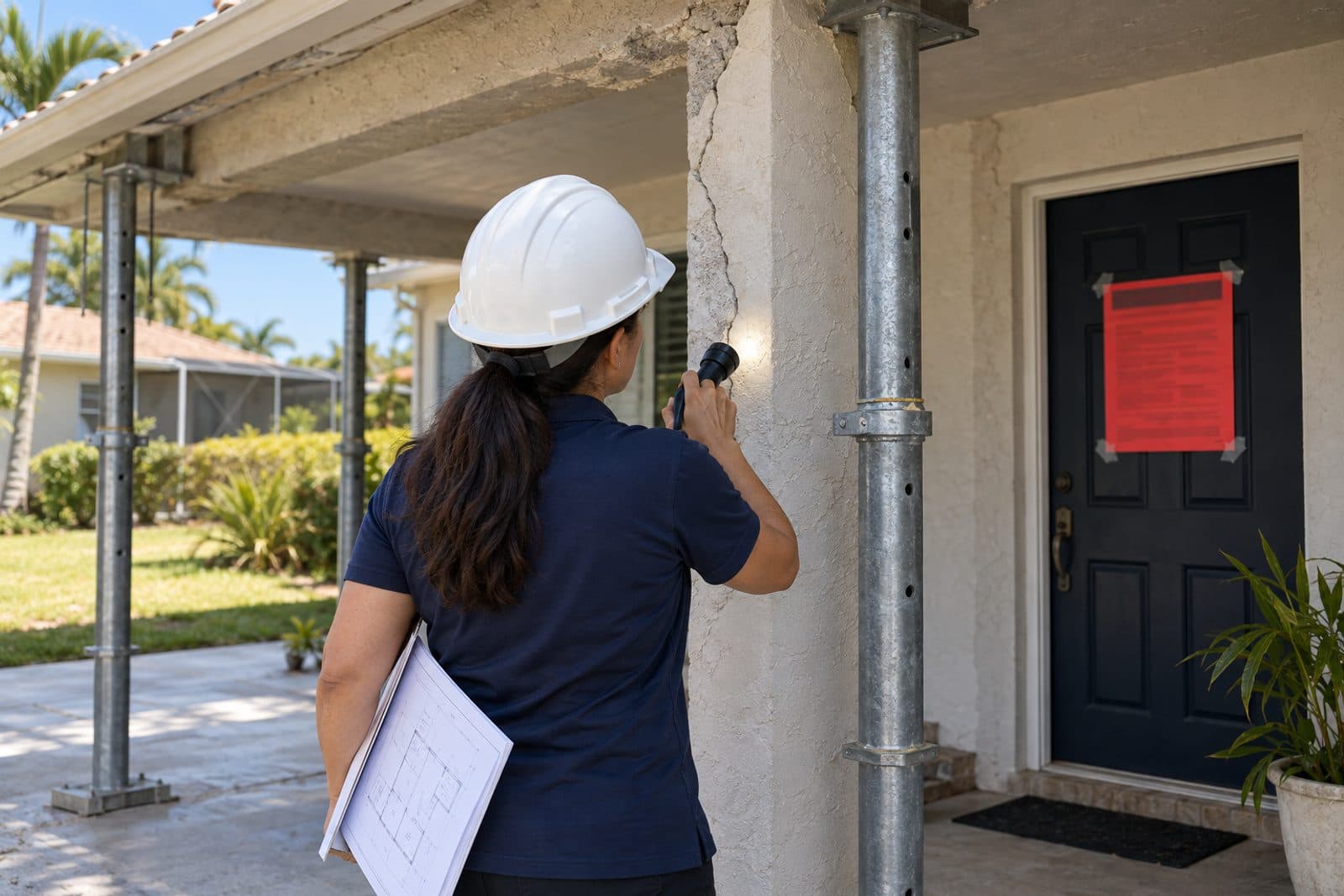
Miami is an incorporated municipality, so code enforcement is normally run by the municipality itself, though some places contract it out — the office that handles your case is the one named on your notice. In Florida, code enforcement is handled locally under Chapter 162, Florida Statutes, which lets cities and counties use either a code enforcement board or a special magistrate. The process generally starts with a notice of violation that gives the owner a reasonable time to correct the problem; if it is not corrected, the case is set for a hearing, and the board or magistrate issues an order with a compliance date. Steps, dates and amounts vary by city and county, so confirm yours with the code office named on your notice.
While your case is open, don't
- Do not use the affected area. An unsafe-structure finding is about people's safety first, so keep everyone out of the area the building official identified until the repairs are done and inspected.
- Do not start permitted work before the permit is issued. Section 105.1 of the Florida Building Code requires a permit for most construction, alteration and repair, and work started without one usually has to be permitted after the fact.
- Do not tear out damaged framing or concrete first. The building department may want to see the condition, and an engineer may need to look at it, so wait until you know what plans and inspections are required.
- Do not let the compliance date or hearing date pass unnoticed. Those dates are stated on your notice, and the code office named on it is who answers questions about them.
- Do not assume an old permit is closed. An open or expired permit stays on the property record until it is properly closed out, so check the status with the local building department.
What we do
- We read the notice with youWe go through the notice or unsafe-structure order line by line and look at the property, so we know exactly what the building official found. Then we tell you what work that condition needs.
- We make the area safe and secure itWhere the finding involves an open or unsecured building, or a failing stair, railing or balcony, the first step is making the area safe and closing it off. That is done before the longer repair work starts.
- We bring in an engineer where plans are requiredWhen the building department requires structural plans, a licensed engineer or architect prepares them. For condominium and cooperative buildings, repairs identified in a structural milestone inspection under section 553.899, Florida Statutes, are permitted and carried out through the local building department.
- We pull the permit and do the repairsWe permit and perform the structural and general repair work under our Florida Certified Building Contractor licence CBC1267336, including after-the-fact permits where the work was already done. Electrical, plumbing and air-conditioning work is done by our Florida-licensed subcontractors, who pull that trade's permit.
- We schedule inspections and work to close the permit outInspections are scheduled as the work reaches each stage, and we work to get the permit closed out. You get the paperwork to show the code office named on your notice.
- We agree the price in writing firstThe estimate is free. We tell you what the violation needs and agree the price in writing before any work starts.
Work by 360 Home Improvements, Florida Certified Building Contractor CBC1267336. Electrical, plumbing and AC work goes to our Florida-licensed subcontractors, who pull that trade's permit.
How it works in Miami
Miami sits on the water, and salt-laden air off Biscayne Bay and the Atlantic corrodes metal far faster than inland. That same salt air and the year-round humidity corrode reinforcing steel and spall concrete on balconies and older buildings, which is one of the common conditions behind these notices. Storm damage left unrepaired is another — roofs still under tarps, damaged structures, scattered debris after a storm. Hurricane season runs June 1 through November 30, and compliance deadlines on a notice still apply as written during it.
Housing here is dominated by concrete block and stucco, with mid-century single-family homes in the older inland neighborhoods and a large share of high-rise condominiums downtown, in Brickell and along the bay. Condominium and cooperative buildings of three or more stories require structural milestone inspections under section 553.899, Florida Statutes, and the repairs that follow go through the local building department. Miami-Dade is part of the High-Velocity Hurricane Zone, so roofing, windows, doors, shutters and similar products installed here need approval for that zone, usually a Miami-Dade Notice of Acceptance. Condo associations and gated communities are very common in Miami, so exterior work often needs HOA approval as well as a permit.
Questions people ask
- The notice gives me a date. Can you finish before it?
- We do not promise a completion date, and no contractor should. What we can do is look at the property, tell you what the work involves and start the permit process. Questions about the date itself go to the code office named on your notice.
- The work was already done without a permit. What now?
- Work done without a permit generally has to be permitted after the fact. That can involve drawings, inspections and opening up finished surfaces so the work can be inspected. We pull after-the-fact permits under our licence.
- My Miami condo had a milestone inspection and the report lists repairs.
- Repairs identified in a milestone inspection under section 553.899, Florida Statutes, are permitted and carried out through the local building department. We do that structural and general repair work under our CBC licence. Confirm applicability and timing with the building department or the Florida Department of Business and Professional Regulation.
- A spalling balcony — is that common in Miami?
- Yes. Salt air and humidity corrode reinforcing steel and spall concrete on balconies and older buildings, which is a frequent reason for unsafe-structure notices here. What has to be repaired, and by when, is set by the building official and the board, not by us.
- Can you deal with the fine or the lien?
- No. We are a contractor, not a law firm: we do not represent owners at hearings and we do not negotiate fines or liens. Those are decided by the code enforcement board, special magistrate or local government named on your notice, and legal questions go to a Florida attorney.
- How do I check your licence?
- We hold a Florida Certified Building Contractor licence, CBC1267336, a state certification valid in every Florida county. Anyone can verify a licence on the Florida DBPR website.
This page is general information about Florida code enforcement, not legal advice. For questions about your own case (deadlines, hearing dates, fines or liens), contact the code enforcement office named on your notice, or a Florida attorney.
Send us the notice
The estimate is free: we read the notice with you, look at the property, tell you what the work involves and agree the price in writing before anything starts — call (954) 906-7864 or send a request through the form on this site. Questions about the case itself, including dates, fines and liens, go to the code enforcement office named on your notice.
Request a free estimate
Tell us what the notice says and where the property is. We'll look at what the violation needs and agree the price with you before any work starts.
Same violation in nearby cities
Unsafe structure or building in disrepair: every Florida city we cover
Other violations in Miami
- Roof citation
- Fence, wall or pool barrier citation
- A lien was recorded on my property
- Daily fines are adding up
- Work done without a permit
- Open or expired permits
- Overgrown lot, yard or debris
Code Violation Solver is run by 360 Home Improvements, a licensed Florida contractor. We fix the condition behind the violation; the code office named on your notice decides the case.